
Fee Lines at 2,098 TH/s: What Each Rate Is Pricing
A fee schedule is really a statement about who carries the risk. At 2,098 TH/s the gross credit is $79.71 a day at $84,692, so the listed 4% on the block-reward component is $3.19 and the listed 2% on the PPLNS-distributed components is $1.59. Small numbers, but each one buys a different arrangement with variance.

Key takeaways
- At 2,098 TH/s, $79.71 of daily gross carries a listed 4% on the block-reward base, which is $3.19.
- The listed 2% applies to the PPLNS-distributed components and comes to $1.59 on the same base.
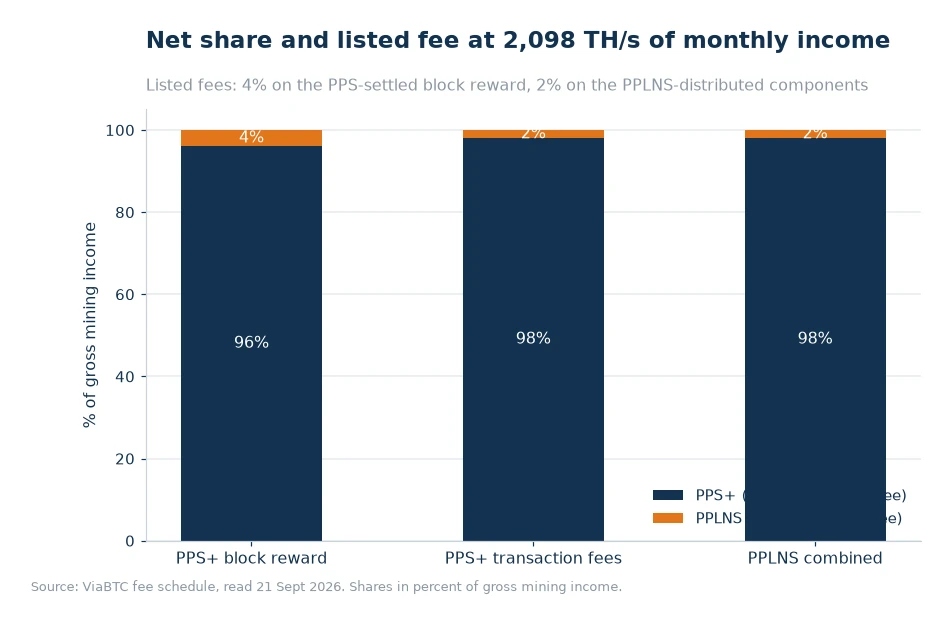
- PPLNS applies the listed 2% to both components combined, so switching modes changes the base as well as the rate.
- A power draw of 41.96 kW at 20 J/TH costs about $60.42 a day at $0.06 per kWh.
A schedule is a map of risk
Every payout mode moves risk somewhere. PPS+ moves the risk of an unlucky pool onto the operator and settles per share, hourly, against current difficulty. PPLNS leaves that risk with the miner and settles once a block reaches 6 confirmations, sharing the miner's slice across the last 5 difficulty rounds. The rates differ because the risks differ, not because one mode is a discount on the other.
There is a third party in this arrangement, and it is the machine. A fault at the miner's end costs the same under either mode, which is why the mode decision should be made after the hardware is stable. Choosing a payout method to offset unreliable hardware is a way of paying for two problems at once.
That framing is more useful than a percentage comparison, because it explains what a miner is buying when they accept a higher rate. They are buying a credit that does not care whether the pool had a slow night. Whether that is worth two percentage points depends on the size of the operation and on how well its cash flow tolerates a thin week.
The three bases at 2,098 TH/s
The table applies each rate to the full daily gross so the rows can be compared directly. In a real PPS+ payout the base is split between subsidy and fees, so the effective deduction sits somewhere between the first two rows.
| Mode and base | Listed rate | Daily deduction | Daily net | 30-day net |
|---|---|---|---|---|
| PPS+, block-reward base | 4% | $3.19 | $76.52 | $2,295.60 |
| PPS+, transaction-fee base | 2% | $1.59 | $78.12 | $2,343.60 |
| PPLNS, both components | 2% | $1.59 | $78.12 | $2,343.60 |
The gap between the top and middle rows is $1.60 a day, or $48.00 across a month, and it is the amount at stake in the PPS+ split. It is a real amount, but it is also small enough that a single day of downtime at $79.71 costs more than a month of it, which is a useful sense of scale before arguing about percentages.
Worked example
Follow the numbers from the network totals through both rates.
- Network output: 3.125 BTC × 144 blocks = 450 BTC a day.
- BTC per TH/s: 450 ÷ 1,003,107,267 = 0.00000044861.
- 2,098 TH/s: 2,098 × 0.00000044861 = 0.00094118 BTC.
- Gross value: 0.00094118 × 84,692 = $79.71.
- Listed 4% on the block-reward component: 79.71 × 0.04 = $3.19.
- Listed 2% on the PPLNS-distributed components: 79.71 × 0.02 = $1.59.
- Thirty days: 79.71 × 30 = $2,391.30 gross, so $95.65 and $47.83 on the two bases.
- Net of the higher rate: 79.71 − 3.19 = $76.52, which is $2,295.60 over the month.
What changes when you switch mode
Switching to PPLNS does not simply cut a rate in half. It changes the base as well, because the block reward joins the transaction fees under one distribution. It also changes when coins arrive: hourly under PPS+, and after confirmations under PPLNS. An operator who switches to save a percentage point and then finds an empty week has traded a known cost for an unknown one.
The switch is most defensible when the operation can absorb a slow stretch without changing its power contract or its loan schedule. It is least defensible when the daily credit is already committed to a fixed payment, because the mode with lower expected cost is also the mode with the wider range of outcomes.
There is also a timing effect worth planning for. A miner who moves to PPLNS mid-month will see the first payouts arrive later than expected, since nothing lands until a block confirms inside the new window. Budget for the gap rather than discovering it, and the transition costs nothing beyond a few quiet days.
The cost the schedule does not mention
At 20 J/TH, 2,098 TH/s draws 41.96 kW, which is 1,007 kWh a day. At $0.06 per kWh that is $60.42, against the $79.71 gross. The margin before hardware and cooling is $19.29 a day, and it is the number that decides whether the operation continues through a difficulty change.
Fees of $3.19 sit inside that margin, not beside it. When the margin narrows, the fee becomes proportionally more visible, which is why operators who run at thin margins care about basis points that a profitable farm would ignore. The same schedule can be a rounding error in one operation and a deciding factor in another, and the difference is the power rate rather than the pool. Check the tariff before the schedule.
The 30-day reconciliation
A month is long enough for the arithmetic to be tested and short enough to remember what happened. Multiply the daily gross by thirty, apply the rates you were charged, and compare the result with the sum of credits in the account. A difference within rounding is a clean month. A difference of several percent is a question about uptime, hashrate or the difficulty path, in that order.
Two habits make the reconciliation quick. Record the difficulty and network hashrate on the first and last day, so a mid-month adjustment is not mistaken for a fault. And note any withdrawal dates, because a transfer moves coins out of the balance without changing what was mined, and the two get confused more often than they should in a monthly review.
Reading the fee page properly
The ViaBTC Pool Fees page lists both rates with the component each applies to, and that pairing is the part to check. Then confirm the settlement rules: hourly against current difficulty for PPS+, and 6 confirmations across the last 5 difficulty rounds for PPLNS. A schedule quoted without those rules is a number without a definition.
Keep the operational side nearby as well. The iOS and Android app shows the credit history as it builds, and the multi-currency wallet holds the balance once it lands. Neither changes the arithmetic, but both make a monthly reconciliation a five-minute job instead of an afternoon.
Frequently asked questions
What are the fees at 2,098 TH/s?
On a gross of $79.71 a day, the listed 4% on the block-reward component is $3.19 and the listed 2% on the PPLNS-distributed components is $1.59.
Does switching to PPLNS remove the 4% rate?
Yes, in the sense that PPLNS applies the listed 2% to the block reward and transaction fees combined, so the block-reward base no longer carries the higher rate.
When is a PPS+ credit paid?
Hourly, against current difficulty, so the balance updates through the day rather than after each block confirms.
Price the risk, then pick the mode
Two percentage points on this base is $1.60 a day. Set that against the cost of an unpredictable week and the decision usually makes itself: if the operation can fund its costs from a bad month, the lower rate is worth having; if it cannot, the steadier series is worth the difference.
Either way, write the chosen rate and its base on the same line as the power cost. That single line is the honest description of what the machine earns, and it is the one to revisit when difficulty moves rather than when a headline does.
Sources: the ViaBTC pricing, download and wallet pages for listed rates and account features[1]. Inputs read 21 Sept 2026: 1,003 EH/s, 132.76 T, 3.125 BTC per block, 144 blocks a day, BTC $84,692. Published 22 Oct 2026; figures assume constant difficulty and no downtime.