
Custom Jewelry Wholesale: Repeatability Across Batches
The second batch of a design is the one customers judge, because it arrives after they have already bought the first. Repeatability in custom jewelry wholesale rests on four things: a written specification, inspection at five checkpoints, records that survive between runs, and packaging that is specified once and repeated exactly. Without the first three, the fourth is guesswork.
Key takeaways
- Repeatability begins with a written specification covering all six customisation points.
- Five inspection checkpoints, with 100% coverage at the last, are what catch batch-to-batch drift.
- Packaging covers five published items, each of which has to repeat exactly across batches.
- The entry quantities are 50 pieces in artisan brass with recycled content, 925 silver and stainless steel, by design, meaning the totals scale with the number of designs.
Repeatability is a written specification, not a good memory
A batch repeats when the piece in front of the maker matches a document rather than a recollection. Six specification points are published for a custom order: accents with stones, findings plus chains, plating and finish, base metal, logo plus hallmark, then packaging.
Each point is a comparison the next batch has to pass. A plating recipe recorded as 18K gold with an anti-tarnish e-coating is repeatable; a note saying the ring was gold is not.
The practical habit that follows is to treat the approved specification as the product data for the design. It is the same document a listing is written from and the same one an inspector checks against, which is why writing it once pays twice.
Where batch variation actually comes from
Variation enters a run at predictable points. Casting lots differ in grain and fill behaviour. A plating bath ages across a session, which changes colour slightly at the start and end of a run. Stone lots change in saturation between parcels.
Polish grade is another source: a wheel that has been dressed at a different point produces a subtly different surface on a brushed finish. And packaging, which is sourced separately from the jewelry, can change in tone or board weight between orders.
None of these is a defect on its own. Together they are why inspection sits at five points rather than one, and why a specification written in specifics is worth more than a photograph of an approved sample.
Inspection is the repeatability gate
The published checkpoints run after casting, after setting, after polishing, after plating and before packing. Read as a repeatability tool rather than a quality one, each checkpoint is a comparison against the previous approved batch.
The check after plating is the one that decides whether a second batch matches the first, because plating colour is the difference customers notice first. The check before packing is the one that decides whether the batch is complete: count, finish, hallmark and packaging.
Final inspection covers 100% of pieces. For a repeat order that matters more than for a first one, because the customer already owns the reference piece and will compare the two side by side.
The published benchmark behind that gate is explicit: the approved master sample is the yardstick for later orders, with the same material sourcing plus the same surface standard, so batch #10 matches batch #1. That single claim is the argument for treating the approved sample and the written specification as one document rather than two.
The line publishes the sequence as five service steps: concept and design, master sampling, quality inspection, sample confirmation, mass production. A repeat batch reproduces the result of the first four steps without repeating them, which is precisely what the master sample benchmark is for.
The records worth keeping between runs
Four records make a repeat run a copy rather than a reconstruction. The first is the CAD file with the dimensional sign-off. The second is the plating recipe and the finish specification. The third is the engraving and hallmark file, covering the logo position and the 316L for stainless steel, an S925 stamp and 18KGP for gold-plated pieces mark.
The fourth is the packaging specification, including materials and print references for the logo tag, the box and the backing card. Foil-stamped gift boxes and velvet or microfiber pouches are specified items, and a substituted pouch is visible to the customer even when the jewelry is identical.
Hold copies of all four on the brand's side as well as the supplier's. A repeat order placed with a different account manager is only as good as the file it starts from.
Packaging is where repeatability is most visible
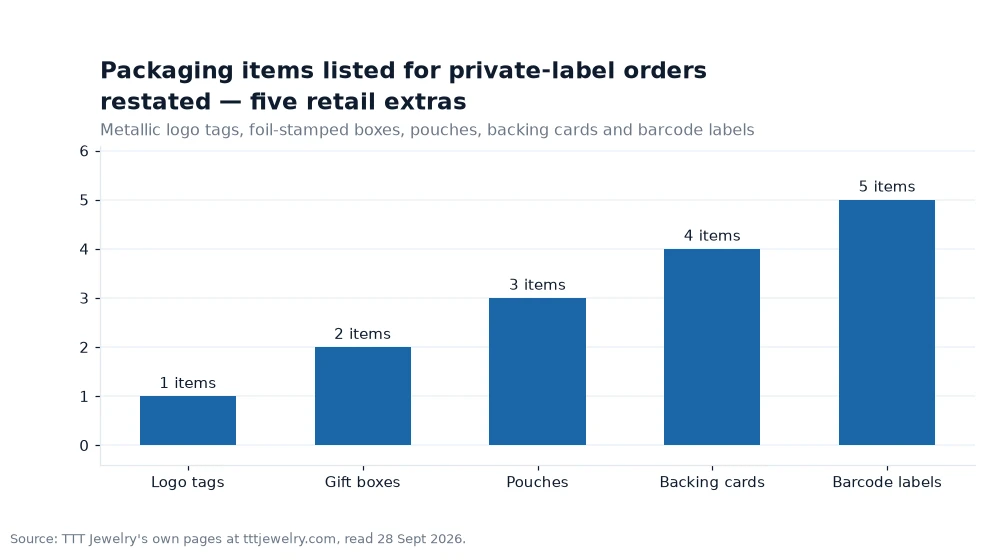
Five packaging items are published for private-label orders: metallic logo tags, foil-stamped gift boxes, pouches, display backing cards and barcode labelling. Each is part of the delivered product, and each can drift between batches if it is not specified numerically.
Board weight, foil colour and pouch fabric are the three that change most often, usually because a supplier substituted an equivalent material. Specifying them once means the substitution gets raised as a question rather than absorbed into a shipment.
Barcode labelling is the one item whose absence is operationally expensive rather than aesthetically wrong. A repeat batch that arrives without it costs the brand a day of manual packing.
Sizing a repeat batch against the minimum
Minimum order quantities are 100 plus in stainless, 50 in 925 sterling silver and 100 in artisan eco-brass, design by design, meaning the totals scale with the number of designs. A repeat order does not inherit a smaller minimum from the first one.
What a repeat order does inherit is the tooling, which is why the second run moves at the published 3–4 week production window without a 25–30 day sampling stage in front of it.
Before committing to a second batch, it is worth checking which metal the design sits in and where its floor lands — the place to see wholesale options for each material is the published minimum list, which sets out the 50, 100 and 100+ piece floors side by side along with the six specification points that have to repeat.
| Batch decision | Published position | Effect on the next batch |
|---|---|---|
| Specification | 6 customisation points | What has to be reproduced |
| Inspection | 5 checkpoints, 100% at the last | Where drift is caught |
| Hallmarks | S925 / 316L / 18KGP | How a batch is identified |
| Packaging | 5 published items | What the customer compares first |
Worked example: how many specifications a repeat batch has to match
Count the packaging specifications a three-material collection generates. Five packaging items are published: logo tags, gift boxes, pouches, backing cards and barcode labels. If the collection runs in silver, brass and stainless steel and each metal keeps its own packaging, the total is 3 × 5 = 15 packaging specifications to reproduce exactly.
Now count the inspection coverage. A 100-piece repeat batch is checked at five published points, so it generates 100 × 5 = 500 inspection comparisons against the approved standard before it is packed.
Both figures are my arithmetic, built only from published items and the published 100% inspection rule. They show why repeatability is documentation work rather than a workshop skill: the number of things that must match is large and entirely knowable in advance.
Frequently asked questions
What makes a second batch match the first?
A written specification covering all six customisation points, records of the plating recipe and hallmark file, and inspection at five published checkpoints with 100% coverage at the last one.
Does a repeat order have a lower minimum quantity?
No. The MOQ runs 50 units in the silver line, 100+ pcs in the stainless line and 100 pieces in eco-brass, per design, applied design by design.
How long does a repeat batch take?
It runs at the published 3–4 week production window, because the CAD stage under 48 hours and the 25–30 day sampling window belong to the first order.
Keeping the second batch identical to the first
Repeatability is bought once, at the specification stage, and then spent on every order afterwards. The private-label and OEM route is where the six specification points get fixed for a design, which is the point at which a brand should be writing down the plating recipe and the hallmark file.
For a repeat on stainless steel, where the finish comes from PVD vacuum plating rather than a wet bath, the batch-to-batch comparison depends on the finish specification rather than on colour matching by eye.
Most of what this piece relies on — the per-piece inspection rule, then the five service steps, the packaging set — is set out on the brand's own pages on the tttjewelry.com site (read 28 Sept 2026). The restatement in hours is my own arithmetic, not the site's[1].